
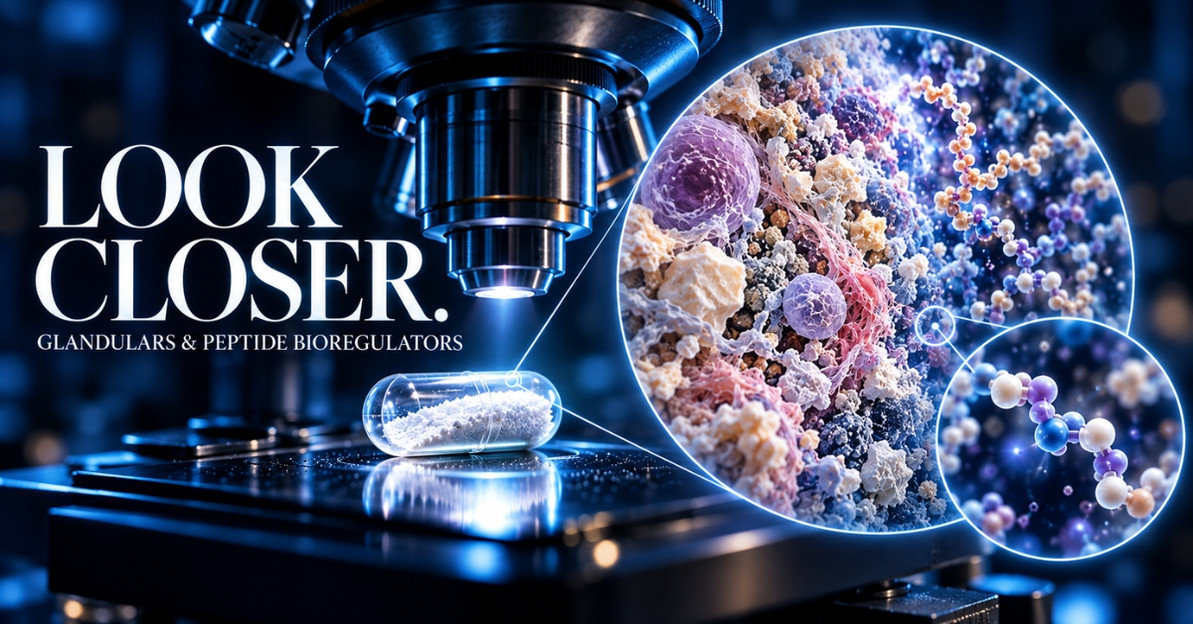
Glandulars and Peptide Bioregulators: What Is the Difference?
A glandular supplement and a peptide bioregulator can look almost identical in capsule form. Both may originate from animal tissue, and both may be sold as fine powders. Their appearance, however, tells us very little about what is inside.
The meaningful difference is composition. A glandular preparation generally retains a broader range of material from a gland or organ. A peptide preparation focuses on chains of amino acids called peptides. How much material remains, and which peptides are present, depends on the way each ingredient is made.
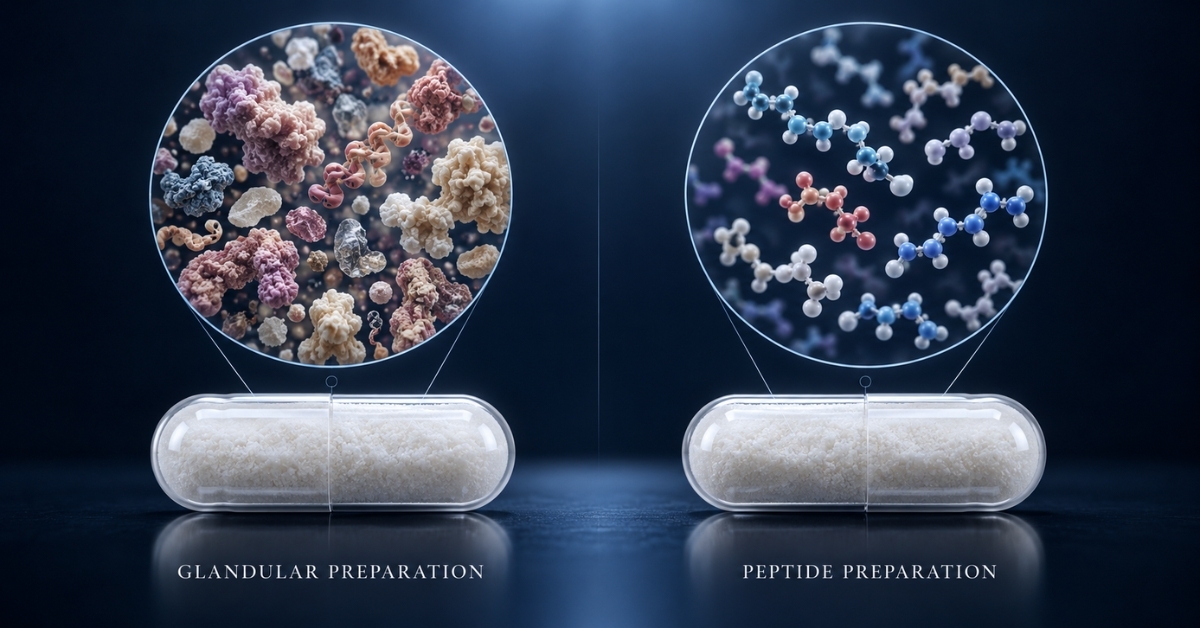
What is a glandular preparation?
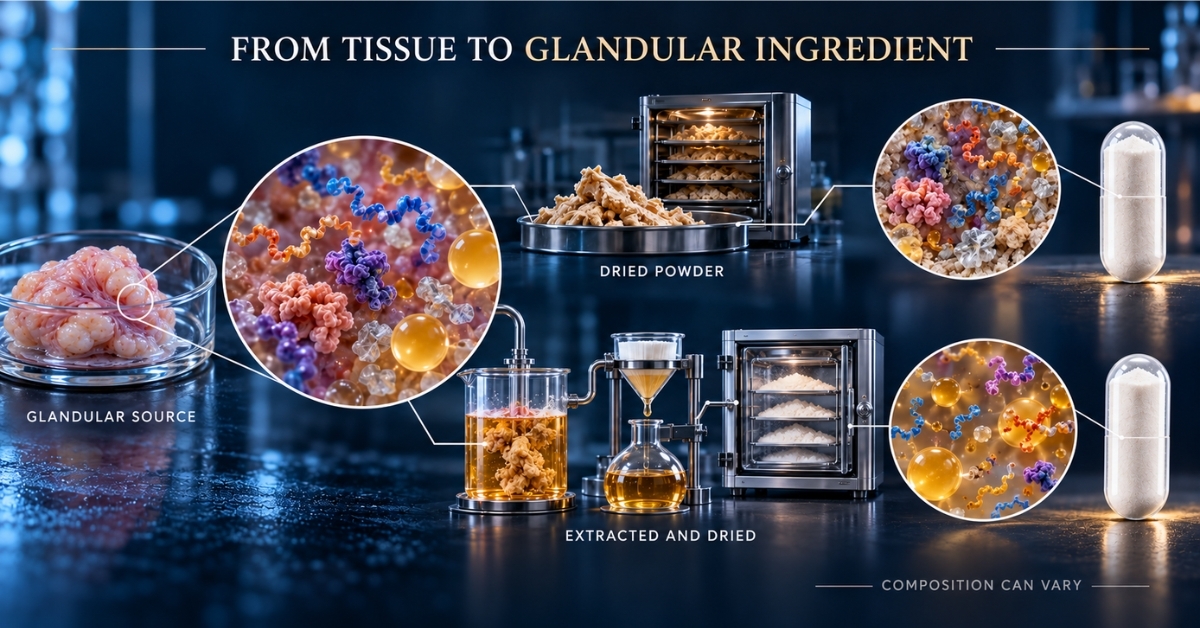
A glandular begins with tissue from an animal gland or organ. The tissue may be dried and prepared as a powder, or it may be used to make an extract. The word glandular describes the ingredient’s source, but it does not describe every substance in the finished product.
That matters because an organ is made of many components. Alongside peptides, its tissue contains larger proteins, fats, minerals, and other biological material. Processing can change that mixture: drying, extraction, and filtration may retain some components while reducing or removing others. Two products made from the same type of organ can therefore have different compositions.
Some glands also produce hormones. This does not mean every glandular supplement contains active hormones. It means that the source tissue and the finished ingredient deserve a closer look. In a published analysis of supplements marketed for “adrenal support”, researchers detected hormones in the products they tested. Those results describe that group of products, not glandulars as a whole. pubmed.ncbi.nlm.nih.gov
What is a peptide bioregulator?
Peptides are short chains of amino acids. The phrase peptide bioregulator is used for different kinds of preparations, so it helps to ask which kind a product contains.
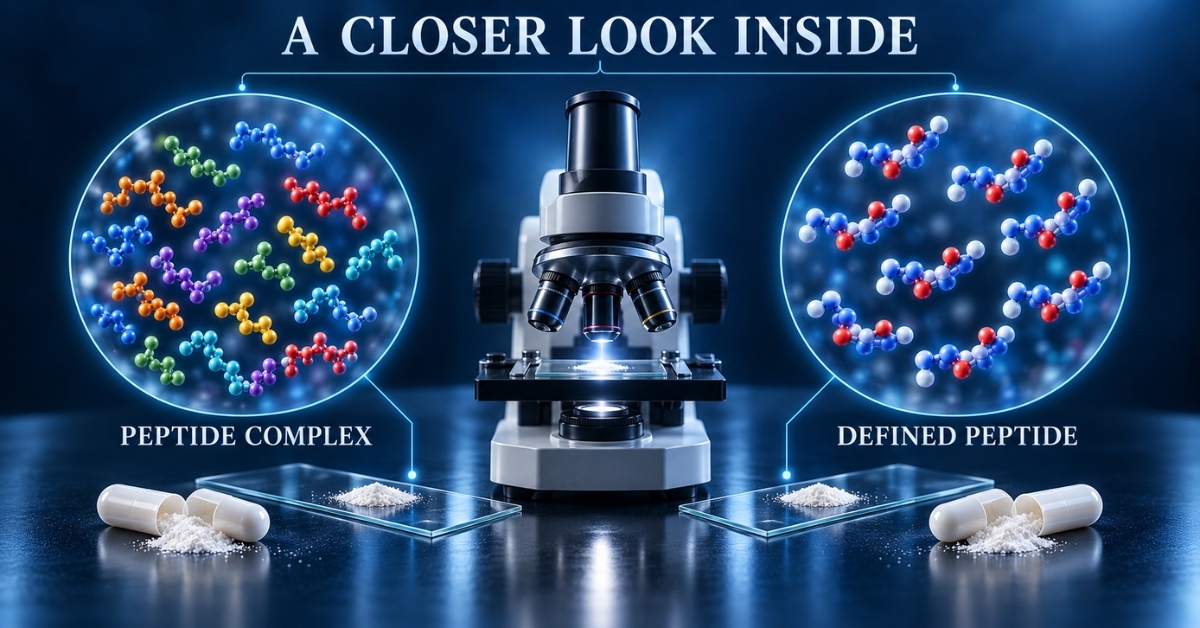
A tissue derived peptide complex begins with biological tissue and contains multiple peptides. A defined peptide has a particular amino acid sequence that can be named and described. Researchers have studied both types; for example, one published cell study examined several defined short peptides alongside Thymalin, which it described as a peptide complex. pubmed.ncbi.nlm.nih.gov
This distinction is central. It would be misleading to describe every peptide bioregulator as one highly purified peptide. Some are mixtures. The term on the front of a bottle is a starting point; the ingredient description tells the reader more.
Can a glandular contain peptides?
Yes. Peptides occur naturally in tissues, which means a broad glandular preparation and a tissue derived peptide preparation are not complete opposites. They may even begin with the same type of organ.
The difference is what the preparation is intended to retain and how its finished composition is characterized. A glandular is typically described in terms of its organ material. A peptide focused preparation is described in terms of its peptide content. A defined peptide is more specific still because its amino acid sequence is known.
Imagine examining a piece of tissue and then examining an ingredient prepared from that tissue. The first tells you about the source. To understand the second, you need information about the processing and finished material. That is why even a real microscopic image of an organ cannot prove what is in a supplement capsule.
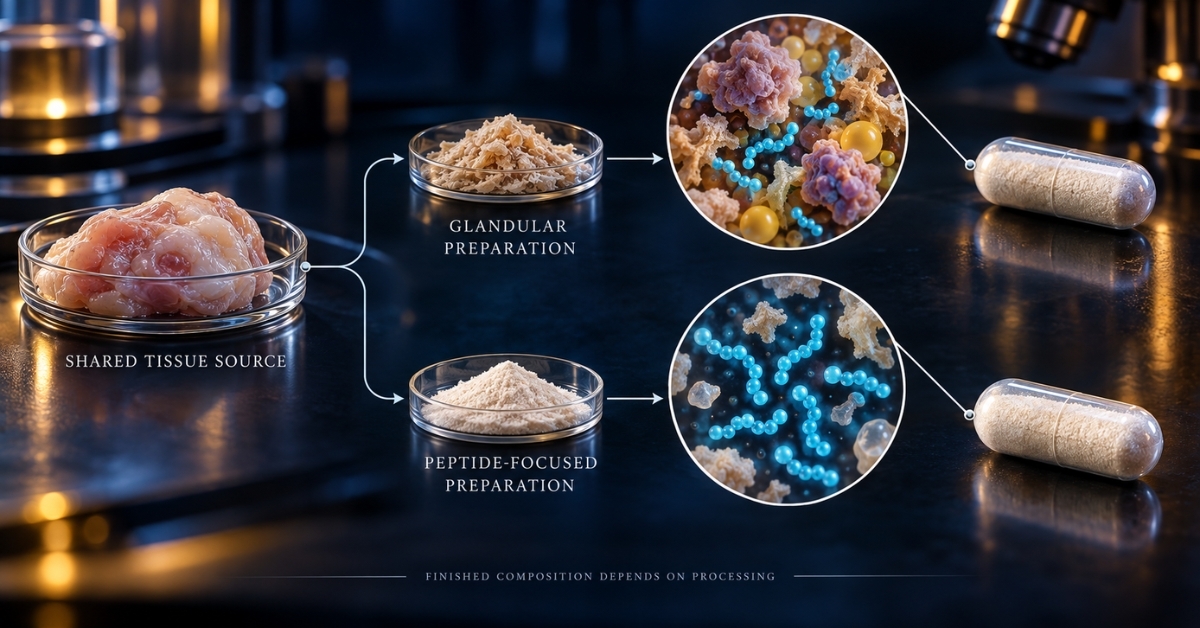
The same organ can lead to different preparations
Consider two ingredients that both begin with thymus tissue. One might be prepared as a broad glandular containing a range of tissue derived material. Another might be processed into a peptide complex containing multiple smaller peptides. A third could be a single peptide with a defined amino acid sequence. All three can be associated with the thymus, but they are not the same ingredient.
This is why an organ name on a label is only part of the story. To understand the preparation, a reader needs to know what was retained after processing. That information is more useful than judging by the source organ, the appearance of the powder, or the word peptide alone. Research has examined defined short peptides alongside a thymus derived peptide complex as distinct preparations. pubmed.ncbi.nlm.nih.gov
How should a reader compare the two?
The clearest question is not simply, “Is this a glandular or a bioregulator?” It is, “What exactly is the finished ingredient?”
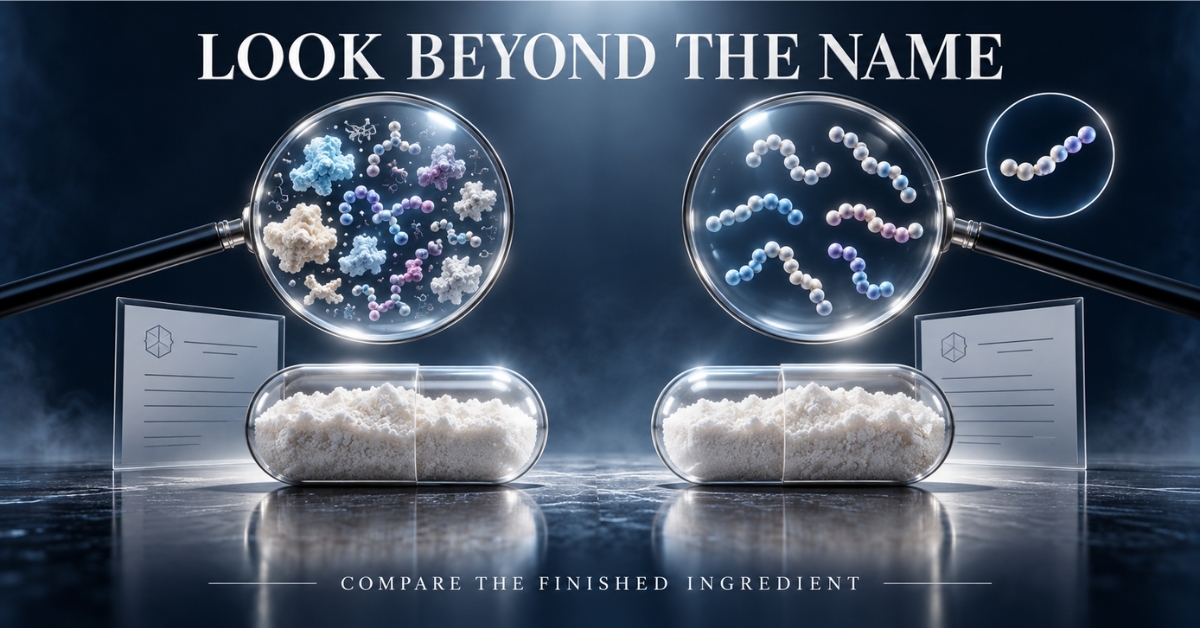
For a glandular, the useful details include the source organ and whether the ingredient is dried tissue or an extract. For a peptide preparation, it helps to know whether it is a tissue derived mixture or a defined sequence. In both cases, information about processing and composition makes the label more meaningful.
That approach also prevents a common mistake: assuming that research on one peptide proves the same thing about every preparation from the associated organ. An organ extract, a mixture of tissue derived peptides, and a single defined peptide are different materials, even when they share a biological starting point. Our article on natural bioregulators and synthetic peptides explores that related distinction in more detail.
The difference in plain language
Glandulars start with organ material and generally retain a broader mixture of tissue derived components. Peptide preparations focus on amino acid chains, but they can range from mixtures of peptides to a single defined sequence.
Neither name alone tells us that a product is more effective, safer, or better tolerated. The strongest comparison looks at the ingredients that are actually in the finished products and the research relevant to each one.
Final thoughts
The source organ is only the beginning of the story. How tissue is processed determines whether the finished preparation is a broader glandular, a peptide complex, or a defined peptide. Understanding that difference helps readers look beyond the appearance of a capsule and ask more useful questions about what it contains.
Explore Vita Peptides
Now that you know why the finished ingredient matters, explore the Vita Peptides collection. Each product page lets you look more closely at the source tissue, and available capsule options.
*Disclaimer: These statements have not been evaluated by the FDA. This product is not intended to diagnose, treat, cure or prevent any disease. Information on this site is provided for informational purposes only and is not meant to substitute for the advice provided by your own physician or healthcare professional. You should not use the information contained herein for diagnosing or treating a health problem or disease, or prescribing medication.
Please note: You should always consult a primary care physician/health practitioner of choice when considering the use of any products for health purposes, especially when undergoing treatment for an existing condition.
Warning: Keep out of direct light. Do not contaminate or touch fluid in bottle. If you are pregnant, nursing, or taking any medication, consult your doctor before use. Discontinue use and consult doctor if any adverse reactions occur. Not intended for use by person under the age of 18. Keep out of reach of children. Store in a dry place and avoid excessive heat.
References
Analysis of hormones in supplements marketed for adrenal support
Cell study examining defined peptides and a peptide complex
Research review on digestion and oral delivery of peptides
Recent Posts
-

Glandulars and Peptide Bioregulators: What Is the Difference?
A glandular supplement and a peptide bioregulator can look almost identical in capsule form. Both ma …Sep 30th 2026 -

Pielotax A 9 Kidney Peptide Bioregulator
The kidneys play an essential role in maintaining the body’s internal balance. They help filter the …Sep 28th 2026 -

Endoluten A-8 Natural Pineal Peptide Bioregulator Guide
The pineal gland is a small endocrine structure located deep within the brain. It is best known for …Sep 25th 2026