
What Are Peptide Bioregulators?
What Are Peptide Bioregulators?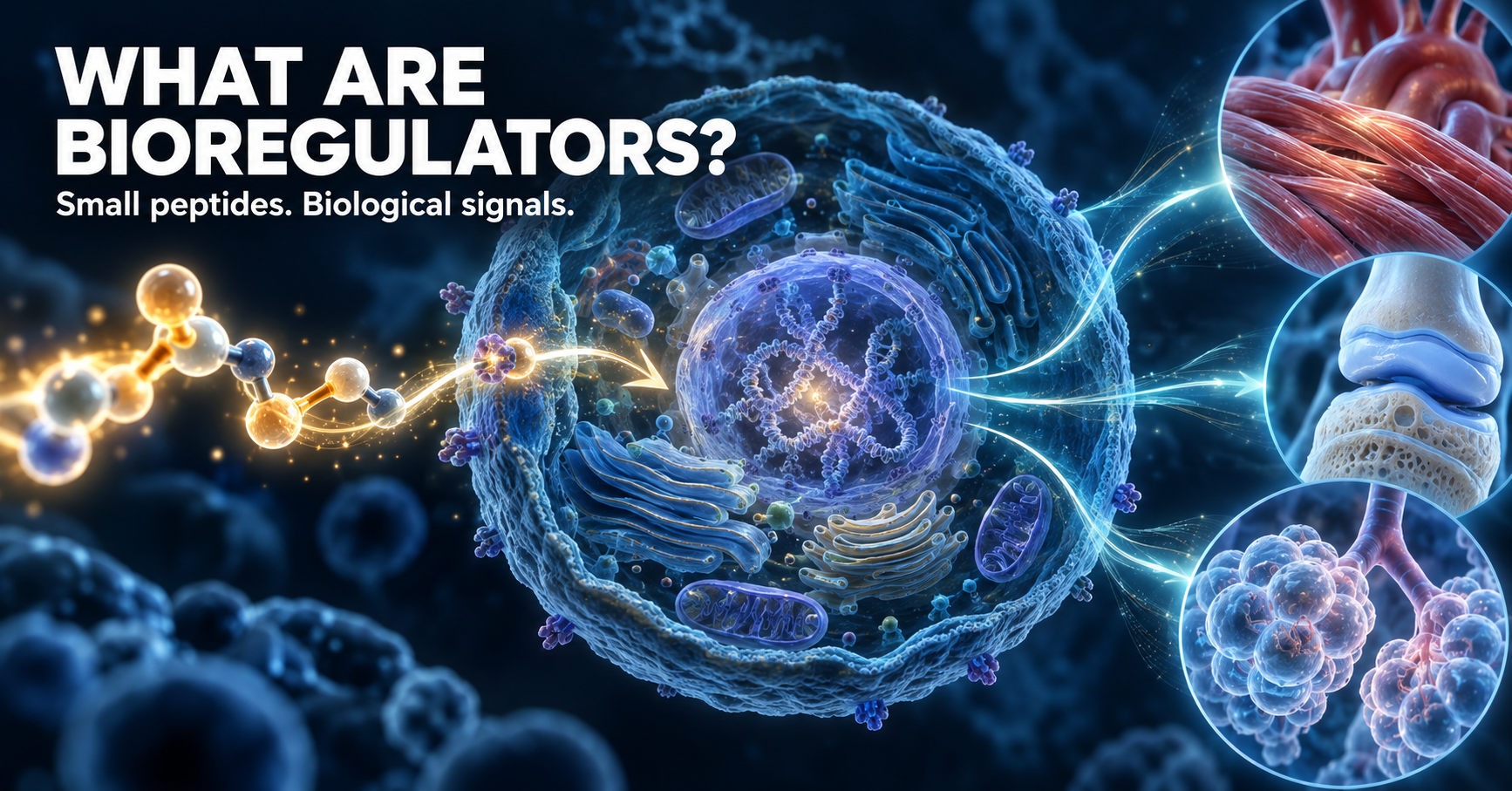 In the Khavinson research concept, bioregulators — more specifically, peptide bioregulators — are described as very short chains of amino acids that the body's own tissues produce to pass signals between cells. The term comes from a school of Russian research led by the gerontologist Vladimir Khavinson, which is why you will also see them called Khavinson peptides. Some are natural peptides extracted from a specific animal tissue, such as the pineal gland or the thymus; others are synthetic copies of the shortest fragments found in those extracts, just two to four amino acids long.
If you have typed “what are bioregulators” into a search bar and landed in a thicket of chemistry, this page is for you. It explains the word, the history, the idea behind it, and the naming system — in plain language, with a few everyday comparisons along the way.
In short
- Bioregulator means “a biological regulator” — a signal, not a building material. Think thermostat, not furnace.
- Peptide bioregulators, in this concept, are the shortest of these signals: two to four amino acids when synthetic, or a low-molecular-weight fraction when extracted from tissue.
- Khavinson peptides is the informal name for the same family, after Vladimir Khavinson, whose group in St. Petersburg developed the concept from the 1970s onward.
- They come in two kinds: natural peptide complexes (extracted from one tissue) and synthetic short peptides (built to match a fragment of that extract).
- They are named after the tissue they come from — pineal peptide, thymus peptide, liver peptide — the way honey is named after the flower.
What does “bioregulator” mean?
Take the word apart and it explains itself. Bio — living. Regulator — something that regulates, adjusts, keeps a process within its normal range. The word describes a substance whose role is to carry an instruction, not to be the raw material that the instruction is about.
An everyday comparison. A thermostat does not heat your house. It has no fuel and no fire. What it has is a message — “a little warmer, please” — that the furnace listens to. If you removed the thermostat, the furnace would still exist and the fuel would still be in the tank, but nobody would be telling the system when to switch on. In this way of thinking, a bioregulator is the thermostat side of biology: small, light, and purely about the message.
The body uses many messengers of this kind — hormones, neurotransmitters, growth factors. In the Khavinson concept, peptide bioregulators are described as one particular class within this large family, defined by two things: they are peptides, and they are exceptionally short.
What is a peptide?
All proteins are built from the same twenty amino acids, joined in a line. A peptide is simply a short line — usually anything under about fifty amino acids. Above that, chemists start calling the chain a protein.
Letters, words, and books. If amino acids are letters, then a protein is a whole book — thousands of letters in a precise order, folded into a shape that does a job. A peptide is a word or a short phrase. And the peptide bioregulators in the Khavinson tradition are the shortest phrases of all: two, three, or four letters. “Turn left.” “Buy milk.” “Start now.” You cannot write a novel with them, but you can leave a very clear note on the fridge.
That shortness is the whole point of the category. A four-amino-acid peptide is tiny even by peptide standards. In the vocabulary of this field, the synthetic ones are called short peptides or ultrashort peptides, and the natural ones are described as low-molecular-weight peptide fractions — a chemist's way of saying “only the small pieces were kept.”
Where Khavinson peptides came from
The story begins in Leningrad in the early 1970s. Two young military physicians, Vladimir Khavinson and Vyacheslav Morozov, were working at the Military Medical Academy on a practical question: do different tissues in the body carry their own sets of chemical instructions, and can those instructions be isolated? Their approach was to take a specific tissue from young animals — the thymus first, then the pineal gland — and isolate the smallest peptides from it, discarding everything large.
The first extracts were given names such as Thymalin and Epithalamin, and over the following two decades the method was applied to one tissue after another: blood vessels, cartilage, liver, kidney, retina, and more. In the 1990s Khavinson founded the St. Petersburg Institute of Bioregulation and Gerontology, which became the home of this line of work; he went on to become a corresponding member of the Russian Academy of Sciences and to hold leadership roles in the European region of the International Association of Gerontology and Geriatrics. The program produced a long trail of publications over those decades — laboratory work, clinical reports, and reviews — which we have collected, with links to the original journals, in a separate Peptide Bioregulator Research Library.
The second chapter came when the group asked a new question: which part of the extract, in their view, was carrying the message? By analyzing the amino-acid composition of each tissue fraction, they identified the shortest recurring fragments and synthesized them in the laboratory as pure sequences. That is how the two- to four-amino-acid synthetic peptide bioregulators were born — the best known being a four-letter sequence from the pineal fraction, Ala-Glu-Asp-Gly, given the name Epitalon.
The phrase Khavinson peptides works like pasteurization or the Doppler effect: it honors the person behind the idea. It is not the name of any single substance or brand — it is the name of a way of thinking about very small molecules.
How do peptide bioregulators work? The idea behind them
This is the question people ask most, so it deserves a careful answer. What follows is the concept of peptide bioregulation as its authors describe it — the way of thinking that gave the category its name. It is presented here as an idea to understand, not as a description of what any product does.
The concept rests on two propositions.
Two comparisons for the two ideas. First, a text message versus a shipping container: in this picture, a cell does not need a warehouse of material to change what it is doing — it needs a short instruction, the way a two-word text can change your whole evening. Second, a house key: a key is cut for one door and is no use at another, and the concept pictures tissue peptides the same way — each tissue with its own key and its own lock.
Within this framework, a peptide bioregulator is one of those short signals, either isolated from the tissue that normally produces it or synthesized to match its sequence. That is the definition; whether and how the concept plays out in any given case is a question this article leaves to the scientific literature and to your own healthcare professional.
Natural peptide complexes vs. synthetic short peptides
Everything in the category falls into one of two groups, and the Khavinson vocabulary has a name for each.
| Natural peptide complexes | Synthetic short peptides | |
|---|---|---|
| Also called | Cytomaxes, natural bioregulators, tissue peptide complexes | Cytogens, short peptides, ultrashort peptides |
| What it is | A mixture of many small peptides extracted from one specific tissue of young animals, filtered to keep only the low-molecular-weight fraction | A single peptide of two to four amino acids, built in a laboratory to match what the developers identified as the most common fragment of the corresponding natural complex |
| How it is described | By the source tissue and the weight of the fraction (for example, “pineal peptide complex, 10 mg”) | By its amino-acid sequence (for example, “Ala-Glu-Asp-Gly”) or a trade name for that sequence |
| Origin | Animal tissue | Chemical synthesis |
Grandmother's soup and the one spice. A natural complex is like a pot of soup made from a family recipe: dozens of ingredients, in proportions nobody wrote down, and the whole pot is the thing. A synthetic peptide is like discovering that one particular spice carries the flavor you remember — and then buying that spice, pure, in a jar. Neither is the “real” version of the other. They are two different ways of getting at the same kitchen.
The words cytomax and cytogen belong to this same vocabulary (cyto- simply means cell), and you will meet both wherever Khavinson peptides are discussed.
Why are bioregulators named after organs?
Because the name tells you where the peptide came from — and nothing more. A “pineal peptide” is a peptide fraction extracted from the pineal gland. A “thymus peptide” came from the thymus. A “liver peptide” came from liver tissue. The tissue word is a statement of origin, exactly like the flower in a jar of honey.
Clover honey, buckwheat honey. When a label says clover honey, it means the bees visited clover. It does not mean the honey is for clover, or made of clover, or does anything to clover. The name is a birthplace. Organ names on peptide bioregulators work the same way: they record which tissue the fraction was taken from. Nothing about the destination is implied by the name.
Over five decades the method has been applied to roughly two dozen tissues. The list reads like an anatomy index: pineal gland, brain, hypothalamus, pituitary, thymus, heart, blood vessels, lungs, bronchi, liver, pancreas, stomach, kidneys, bladder, cartilage, bone marrow, thyroid, parathyroid, adrenal glands, retina, prostate, testes, ovaries. Each tissue gave its name to a natural complex, and several also gave rise to a synthetic short peptide designed from that complex.
Who makes peptide bioregulators today?
Peptide bioregulators are made by several companies, and each gives its products its own trade names. Knowing the main brands makes catalogs, forums, and articles much easier to read.
GARMONIA is a St. Petersburg company that grew out of the Khavinson research program and is the best-known manufacturer. It sells natural peptide complexes under the Cytomax line — each with a catalog code and a trade name — and synthetic short peptides under the Cytogen line. Vita Peptides is a separate line with its own trade names for the same tissue categories. Cytamins is an older line of organ preparations from a different Russian manufacturer. Other brands, including some made outside Russia, sometimes mention a GARMONIA name in their listings for comparison; a product sold under another brand is a different product from a different maker.
This article describes brands at the level of the company and its product lines; it does not compare clinical effectiveness or recommend a particular product. Brand and line names are trademarks of their respective owners. Individual product names and catalog codes, arranged by source tissue, are listed on a separate page: Peptide Bioregulators by Organ: Brands, Product Names, and Catalog Codes.
A short glossary of bioregulator terms
- Bioregulator
- A word for a substance described as regulating a biological process by carrying a signal rather than by serving as material. In everyday use online, the word almost always means a peptide bioregulator of the Khavinson type.
- Peptide bioregulator
- A short peptide — extracted from a specific tissue or synthesized to match a fragment of that extract — belonging to the family developed by Vladimir Khavinson's research group.
- Khavinson peptides
- An informal collective name for the same family, after its originator. Not a brand and not a single molecule.
- Natural peptide complex (cytomax)
- A low-molecular-weight peptide fraction extracted from one animal tissue. A mixture, described by its source tissue.
- Synthetic short peptide (cytogen)
- A single peptide of two to four amino acids, made by chemical synthesis to match the most common fragment of a natural complex. Described by its sequence.
- Epitalon (Epithalon)
- The most widely known synthetic short peptide of this school: Ala-Glu-Asp-Gly, four amino acids, designed from the pineal-gland fraction.
- Thymalin, Epithalamin
- The names of the first two tissue extracts made by Khavinson and Morozov in the 1970s — from the thymus and the pineal gland respectively. They belong to the history of the field rather than to today's vocabulary.
- Low-molecular-weight fraction
- The portion of a tissue extract that passes a size filter — in this field, typically molecules under about 10,000 daltons. It is what “natural peptide complex” means in chemical terms.
Frequently asked questions about bioregulators
What are bioregulators, in one sentence?
In the concept developed by Vladimir Khavinson's research group in St. Petersburg, peptide bioregulators are short natural or synthetic peptides studied for a regulatory role rather than a building role.
Is there a difference between “bioregulators” and “peptide bioregulators”?
Strictly, “bioregulator” is the broader word and could describe any regulatory molecule. In practice, when people search for or write about bioregulators today, they almost always mean peptide bioregulators of the Khavinson type. On this page the two terms are used interchangeably.
What are Khavinson peptides?
The same thing under a different name. “Khavinson peptides” credits the scientist who developed the category; “peptide bioregulators” describes what the molecules are. Both refer to the family of natural tissue peptide complexes and synthetic short peptides described above.
How do peptide bioregulators work?
The concept behind them proposes that cells coordinate through short peptide signals and that each tissue has its own specific signals. A peptide bioregulator, in this framework, is one such signal, isolated from tissue or synthesized to match it. That is the idea as its authors describe it — an explanation of the term, not an evaluation of any product.
Are peptide bioregulators natural or synthetic?
Both kinds exist. Natural peptide complexes are extracted from a single animal tissue and contain many small peptides. Synthetic short peptides are made in a laboratory as one defined sequence of two to four amino acids. Each kind has its own name, its own description, and its own place in the history of the field.
Why are peptide bioregulators named after organs?
The organ name records where the peptide fraction was extracted from — pineal gland, thymus, liver, and so on. It is a statement of origin, like the flower named on a jar of honey, and nothing else should be read into it.
Is there a full list of peptide bioregulators?
The family covers roughly two dozen tissues — pineal gland, brain, hypothalamus, pituitary, thymus, heart, blood vessels, lungs, liver, pancreas, stomach, kidneys, bladder, cartilage, bone marrow, thyroid, parathyroid, adrenal glands, retina, prostate, testes, and ovaries among them — with a natural complex for each and a synthetic short peptide for several. Manufacturers give each one a trade name and, in GARMONIA's case, a catalog code; the full list arranged by source tissue is on the Peptide Bioregulators by Organ page.
Where can I read the original research?
The main publications from the Khavinson program — from the 1970s tissue extracts to the later work on synthetic short peptides — are listed in our Peptide Bioregulator Research Library, each with a note on what was studied and a link to the journal where it appeared.
Who was Vladimir Khavinson?
A Russian gerontologist (1946–2024) who, with Vyacheslav Morozov, began isolating short tissue peptides in Leningrad in the 1970s, founded the St. Petersburg Institute of Bioregulation and Gerontology, and led the research program from which the whole category of peptide bioregulators takes its name.
About this article. This page is published by Vita Stream Inc for educational purposes only. It explains a term, its history, and the idea behind it, and it names the main brands in the category. It is not medical advice, does not evaluate the clinical effectiveness of individual products, and is not a recommendation to use a particular product. Please discuss any questions about your own health with a qualified healthcare professional.